
New Design
The 209-Class
Unlike our predecessors, we recognize the accomplishments of the German Zeppelin Company, the only successful LTA program in history.
For this reason, our design is based on the Hindenburg, which is Germany’s most advanced LTA design.
This represents a completely different approach to that of our contemporaries, as we are seeking to revive LTA, not reinvent the technology, which is the most cost-effective path and one that guarantees we begin with a proven, all-weather airworthy design.
Zeppelin Basic Design Components
- Ellipsoidal shape
- Rigid internal airframe
- Strong Keel
- Multi-bay design, each having a single gas cell
- Empennage with built-in control fin spars
- Resilient outer cover
- External control car, aka bridge
- External power cars
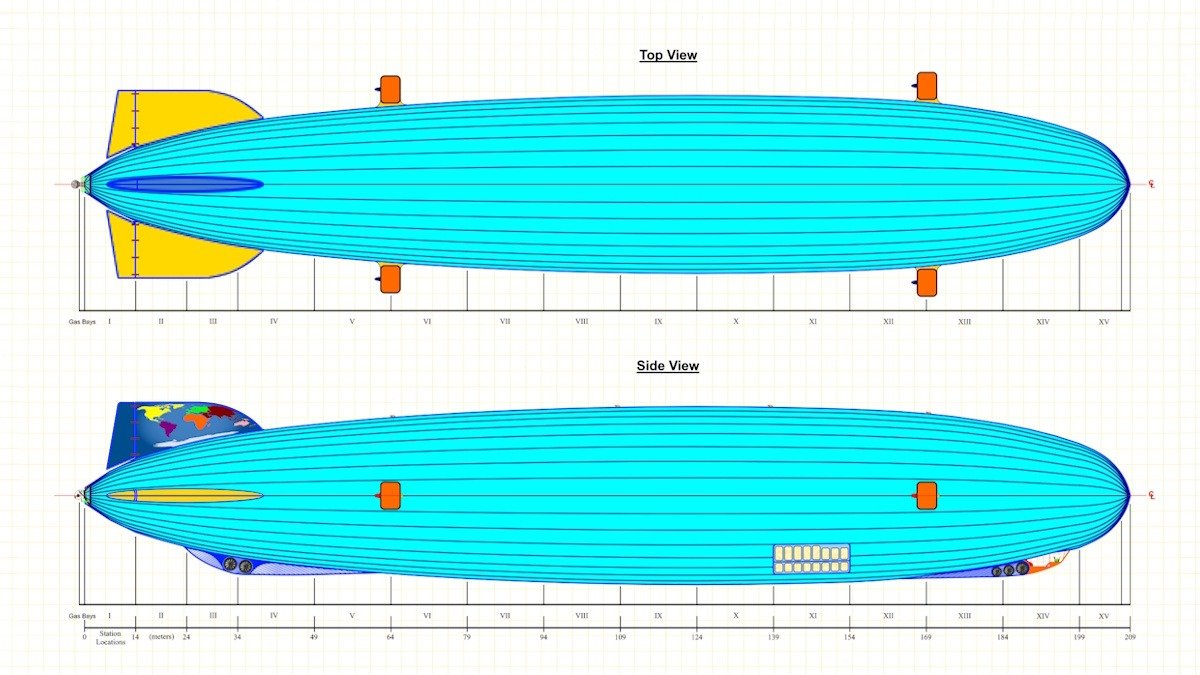
Top & Side Views with Bay locations
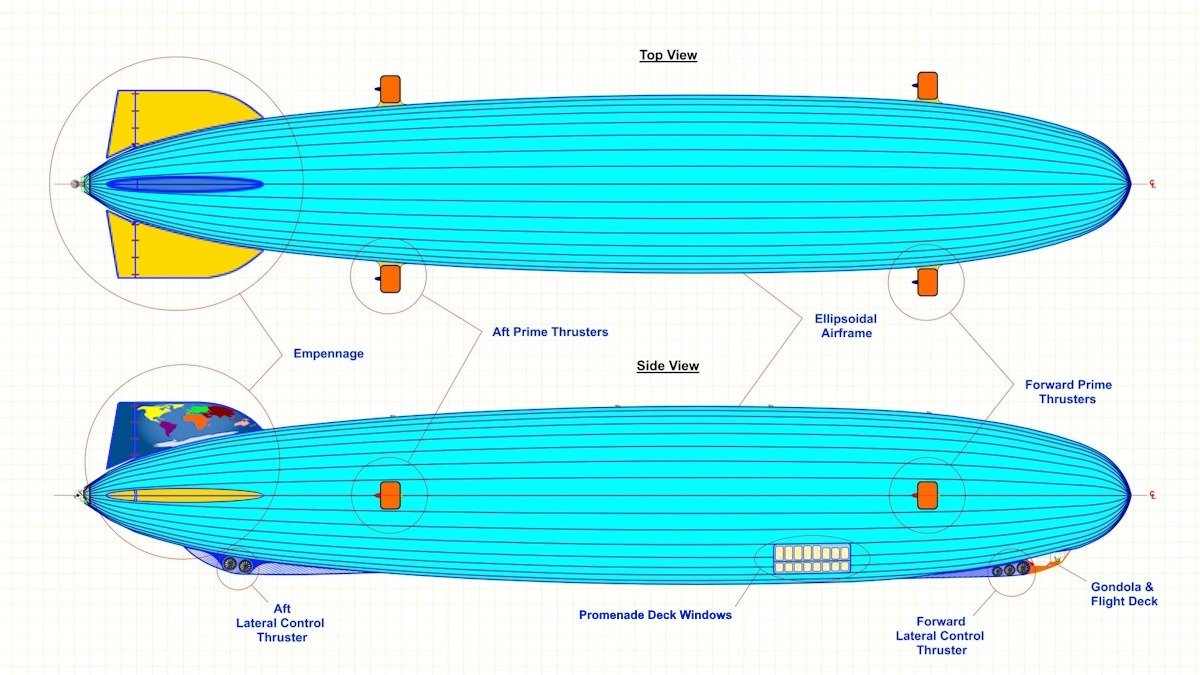
Major Components
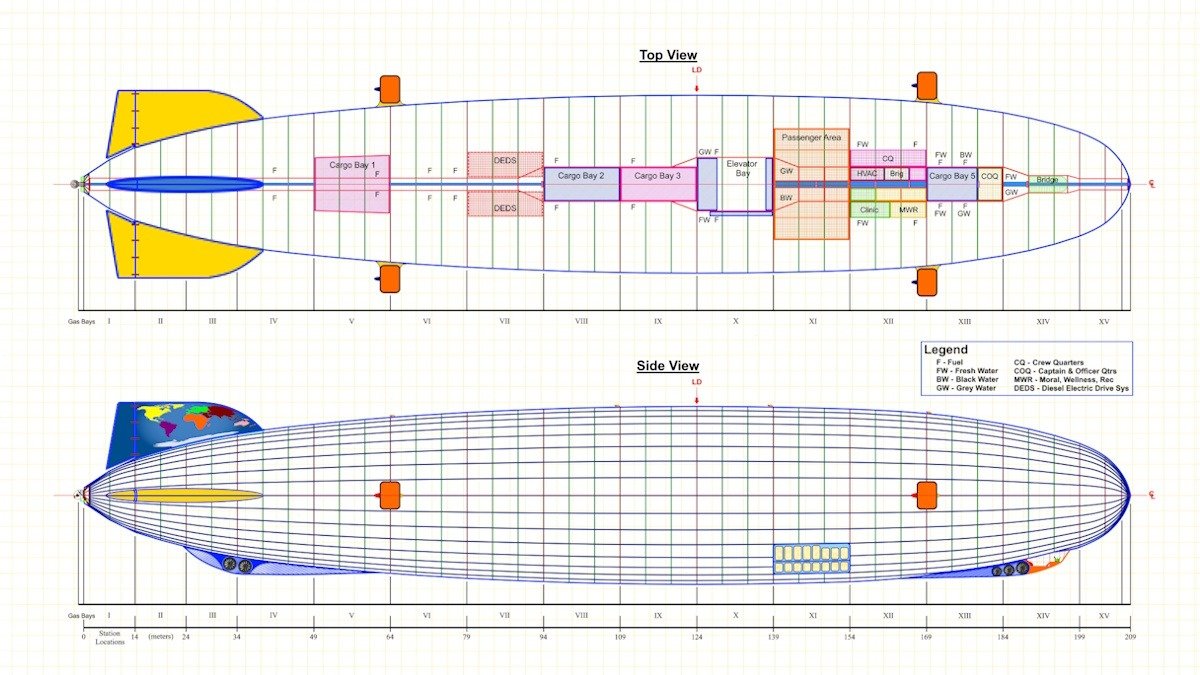
Keel Layout & Airframe Design
Minimum Capabilities
Capabilities required to reintroduce LTA:
- All-weather operations capability
- Accommodations for 40 passengers and 12 crew
- 10-day provision capacity at full compliment
- 75 mph cruise capability
- Maximum range of at least 4,500 miles
- Maximum operating ceiling of at least 10,000 feet
- 20-ton payload capacity at full compliment
Minimum Design Requirements
Design requirements for profitable operations:
- Must possess built-in resiliency
- Incorporate basic German design components
- Buoyancy control should be accurate and dependable
- Flight control must be simple and intuitive
- Must maximize fuel economy
- Reasonable ownership cost
- Operating costs must be minimized
The Buoyancy Management System
A successful LTA program demands reliable, accurate buoyancy management.
When passengers or freight are loaded, adding to the weight of the airship, additional buoyancy must be added.
Conversely, when passengers or freight are unloaded, reducing the weight of the airship, the extra buoyancy must be removed.
This process is referred to as buoyancy management.
The most extreme example of buoyancy management is when a single heavy load is added or removed, as this represents the point at which the largest volume of lift gas must be managed within the shortest possible time.
The two most buoyant lift gases are hydrogen and helium, with helium being the popular choice because it’s nonflammable.
A functional buoyancy management system must have the capability to deploy a large volume of lift gas in a short period of time and then, when the additional buoyancy is no longer needed, compress and store that same volume in the shortest time possible.
Storing the lift gas on board, versus releasing it into the atmosphere, reduces operating costs and guarantees the lift gas is available for the next load.
Interestingly, of the many failed LTA programs, only a couple incorporated a moderately functional buoyancy management system.
Accurate and timely buoyancy management is a requirement for a successful LTA program and was one of the first problems we solved for our project.
More Resources
For a deeper dive into German airship design and capabilities, see the following resources: