
Prototyping
Prototyping – what is it, and is it necessary?
What is a prototype?
Merriam-Webster definition:
- an original model on which something is patterned : archetype
- a first full-scale and usually functional form of a new type or design of a construction (such as an airplane)
Based on the Merriam-Webster definition, a prototype is the first full-scale, fully functional form of a new product.
This is an important distinction, as there are some who advocate building a scaled-down version first, then once testing is completed, move to full-scale construction of the product.
There are virtually no industries today that require the prototype of a new product to be a scaled-down version.
This is primarily because it is more cost-effective to build and test at full scale because many of the problems encountered with the smaller version aren’t carried forward when the product is scaled to its final dimensions.
In addition, the full-scale version always has its own unique set of problems that must be solved. This phenomenon is referred to as the scaling effect.
In other words, innovators have decided it’s not prudent to waste valuable time and resources solving problems encountered with a scaled-down version of a new product if those problems aren’t going to carry forward to the full-scale version and that the full-scale version itself has its own unique set of problems that must be solved.
In today’s transportation industry, whether it’s trucking, shipping by vessel, rail, or commercial and military aircraft, it’s common practice to prove any new design’s integrity by subjecting its full-scale version to real-world circumstances, followed by necessary changes and retesting.
This is the most logical and economical path to product perfection.
Today's LTA Industry
Contemporary LTA (Lighter-than-Air technology) is one of the few industries where smaller-scale prototyping is still practiced. This is primarily due to the high cost associated with pursuing unproven designs, a byproduct of a lack of experience with LTA, while simultaneously trying to reinvent the technology.
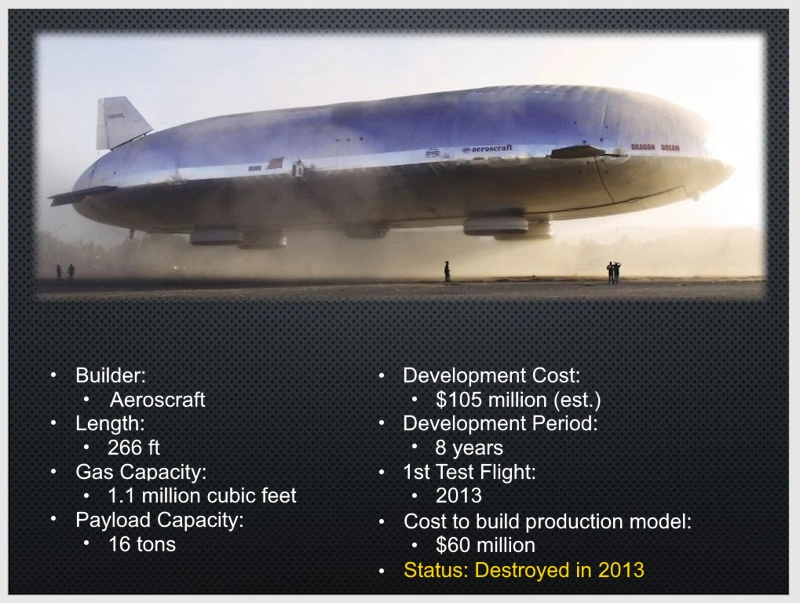
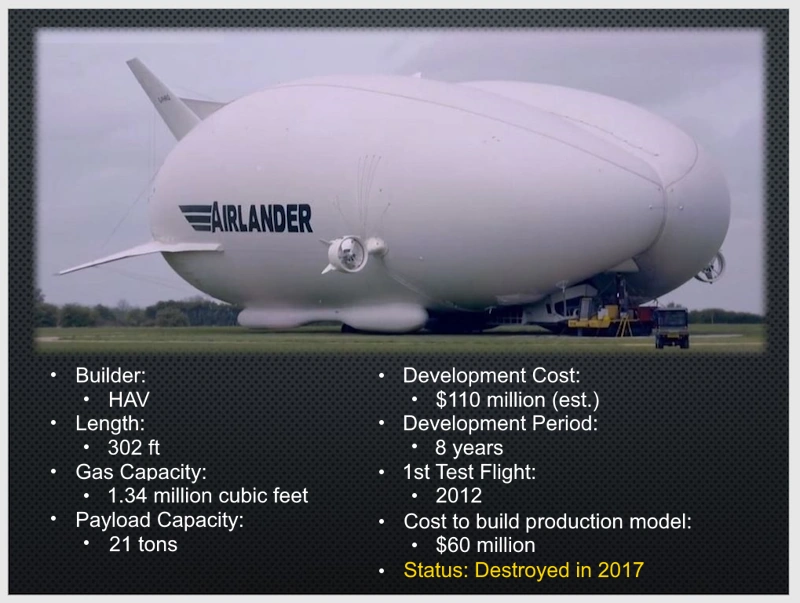
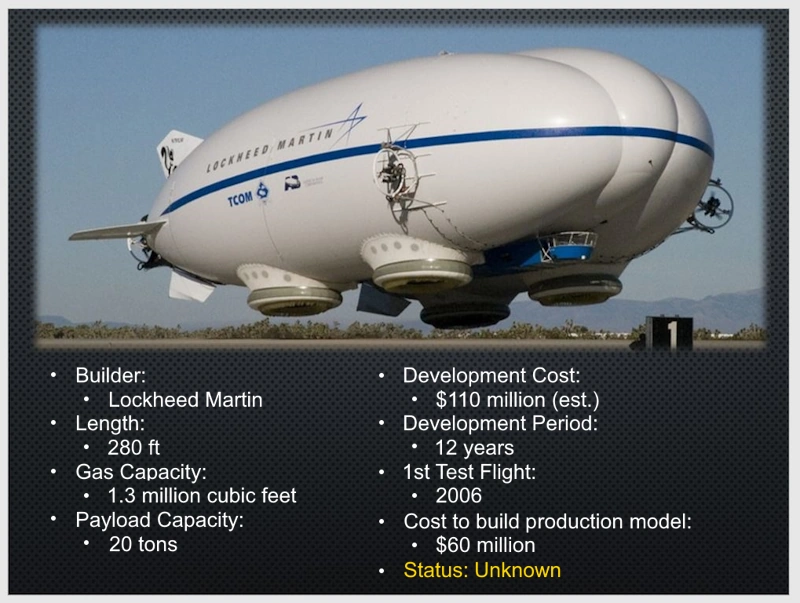
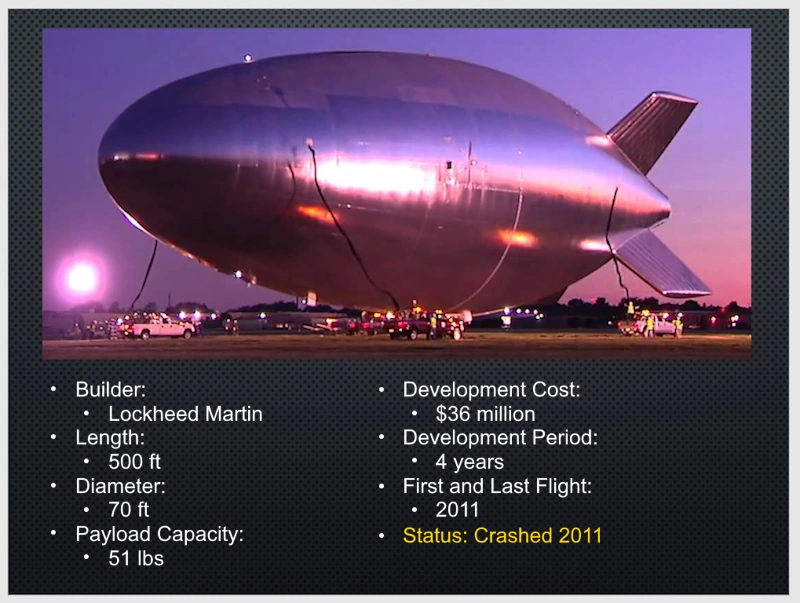
The following taxpayer-funded projects are good examples of how high development costs coupled with a lack of proof of concept ended in too much risk and little ROI for investors.
In each of the cases, the private companies that were tasked with developing a working product spent decades and hundreds of millions of taxpayer dollars only to produce scaled-down prototypes possessing no real capabilities.
As a result, they could not demonstrate to the public what an LTA aircraft of the “airship” class could achieve and only succeeded in building an aircraft with the airworthiness and capability of a blimp—meaning no real marketable value.
In addition, each of the companies mentioned wanted an additional $60 million investment to build a full-scale version of their unproven design.
Consequently, all 4 programs failed with no benefit to the American taxpayer for the more than $1.2 billion consumed.
For additional information on the status of these projects, see our video presentation “LTA Today” on the “Pitch Deck” page of this website.
In addition, see the full report issued in 2013 by the US Government’s Accountability Office (GAO) on the cost and duration of the LTA projects mentioned and more by clicking this link.
Aeroscraft - Dragon Dream
HAV - Airlander 10
Lockheed Martin - P791
US Army - Hale-D
LTA Classifications
In general, there are 4 classifications of LTA aircraft:
- Hot air balloons
- Blimps
- Prototypes
- Airships
To be considered a member of the “airship” class, an LTA aircraft must possess built-in resiliency and have the capability to carry passengers or freight nonstop for thousands of miles day or night in all types of weather and be able to withstand torrential rain, high winds, wind shear, lightning, Saint Elmo’s fire, hail, extreme heat, extreme cold, and extreme humidity.
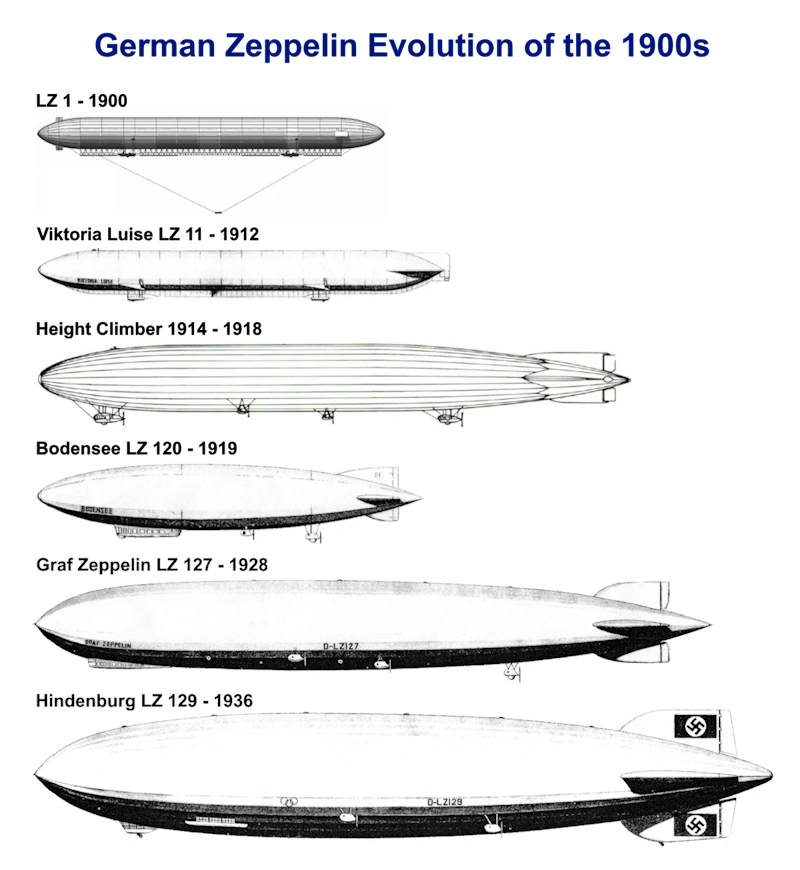
This bar was set by the German Zeppelin Company in the early 1900s when they built and operated 140 airships over a 40-year period and transported the first passengers and cargo by air across continents, oceans, and around the world.
For more information on these topics, see our video presentations “Airship vs. Blimp” and “Passenger Flight Operations” on the “Pitch Deck” page of this website.
Our Philosophy
At Voyager Global, we have a different philosophy from our contemporaries.
We are reviving, not reinventing LTA.
Through research, we have realized that the German Zeppelin airship program was and still remains the only successful LTA program in history.
For this reason, we are basing the design of our airship, aka prototype, on their most advanced design, which was embodied in their Hindenburg and Graf Zeppelin II airships.
To more clearly understand the incredible accomplishments of the German Zeppelin Company of the early 1900s, consider that it has been nearly 90 years since the Hindenburg fire and despite our modern manufacturing, superior build materials, advanced 3D design, and free and open access to global knowledge via the internet, there have been no less than 10 failed airship programs costing taxpayers and investors more than $2 billion.
In contrast, over a 40-year period, the Germans developed and perfected their design, built 140 airships, used 80 of them to bomb England and her allies in WWI, flew in all types of weather, set airship altitude and distance records that still stand today, and transported the first passengers and cargo by air across continents, oceans, and around the world in hydrogen-filled airships constructed of inferior materials, powered by 1900s diesel engines equipped with wooden propellers, using dead reckoning, incomplete maps, and virtually no weather prediction—20 years ahead of the aeroplane and on a much smaller budget.
For more information on the German Zeppelin design, see our video presentations “Airship Design 101” and “German Airship Resiliency” on the “Pitch Deck” page of this website.
Final Thoughts
Recently I read an article published in 2022 on airship development that was titled, “The Tech is Finally Good Enough for an Airship Revival.”
Although what the author is presenting is absurd, given that at any time since the German airship era we have had access to superior build materials, manufacturing, and advanced engineering, it seems many today think of airship building in the same vein as pyramid construction—it’s only possible with massive resources, decades of trial and error, and millions in capital.
This could not be further from the truth.
By learning from the professionals of the German Zeppelin Company, we can begin where they were halted and forgo most of the R&D costs associated with developing an unproven design as well as avoid major mistakes caused by inexperience with the technology.
Because of its inherent efficiency advantages and use of an advanced transportation infrastructure, the Earth’s atmosphere, Lighter-than-Air technology (LTA) will transform transportation as we know it today, providing more cost-effective movement of passengers and freight while simultaneously boosting the growth of the world’s economies.
LTA isn’t old and outdated; it’s the future of transportation.