
Gravity: LTA's Renewable Energy
Solar and wind are fair-weather technologies; this is an unfortunate reality.
If the sun isn’t shining or the wind blowing just so, neither produces electricity, and both are MIA during extreme weather events when they are needed the most.
There is a more efficient and dependable approach to reducing the world’s dependence on hydrocarbons.
Gravity: the only reliable renewable energy!
Gravity is always present with the same intensity, day or night, despite the weather.
The United Nations defines renewable energy as “any energy derived from natural sources that are replenished at a higher rate than they are consumed.”
How is gravity used as a source of renewable energy?
One example is hydroelectric power generation, where gravitational force is used to push water through turbines to produce electricity.
This is the most efficient form of power generation today.
How else can gravity be used as a renewable energy?
Gravity creates air density, which causes buoyancy, and buoyancy can be used to perform work like lifting a load.
Using buoyancy to perform work requires zero energy consumption, as demonstrated in the image below!

The Earth's Atmosphere
Air density is the result of gravity acting on the air in the earth’s atmosphere, which is more than 300 miles deep.

Air Density & Pressure
Air has mass and, therefore, weight. It’s the weight of the air in the upper atmosphere that compresses the air in the lower atmosphere, increasing its density and air pressure.
In the image below, the air pressure at the top of the atmosphere is minuscule, but at sea level it increases to 14.7 pounds per square inch, which means there are 14.7 pounds of air pressing down on each square inch of the earth’s surface.
This doesn’t sound like much until you consider the effect of this pressure on a larger area. For example, at sea level an area just 10 feet square, the size of a small bedroom, is experiencing 211,680 pounds of downward force from the weight of the air in the earth’s atmosphere.

How much does gravity affect fuel consumption?
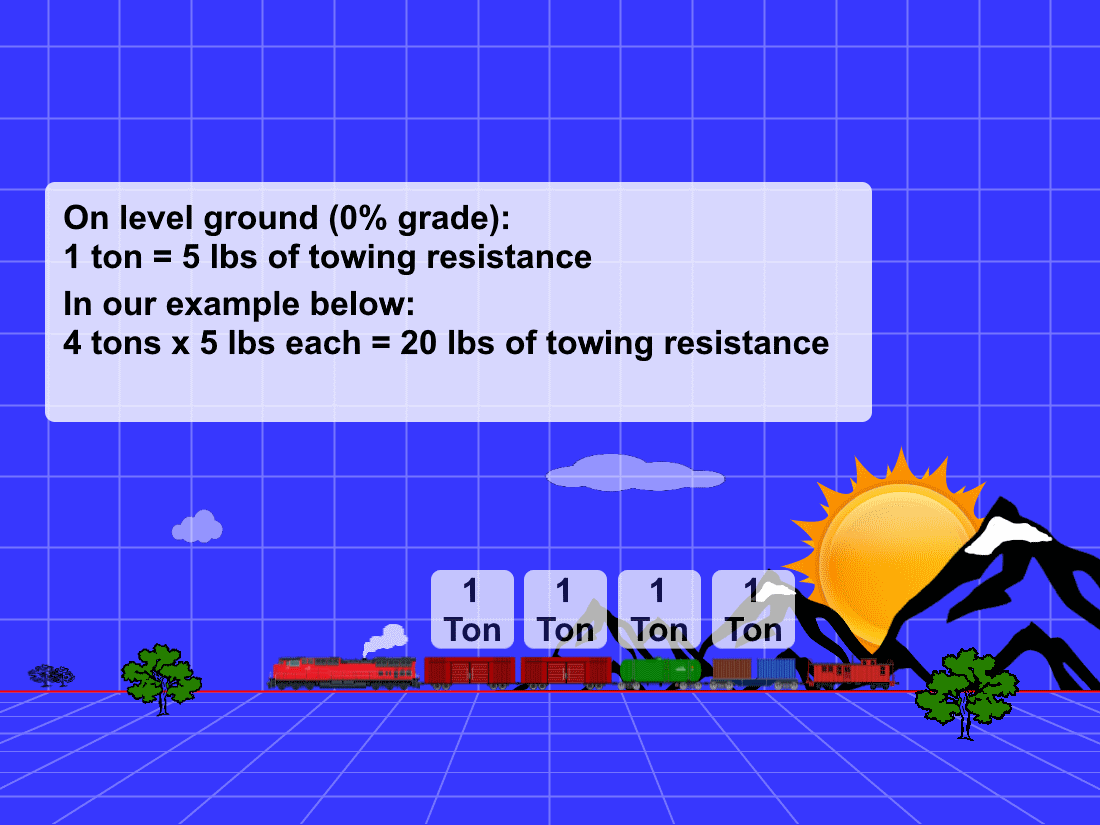
As displayed in the first image below, on a level track (0% grade), only 5 pounds of force is required to move 2,000 pounds of load.
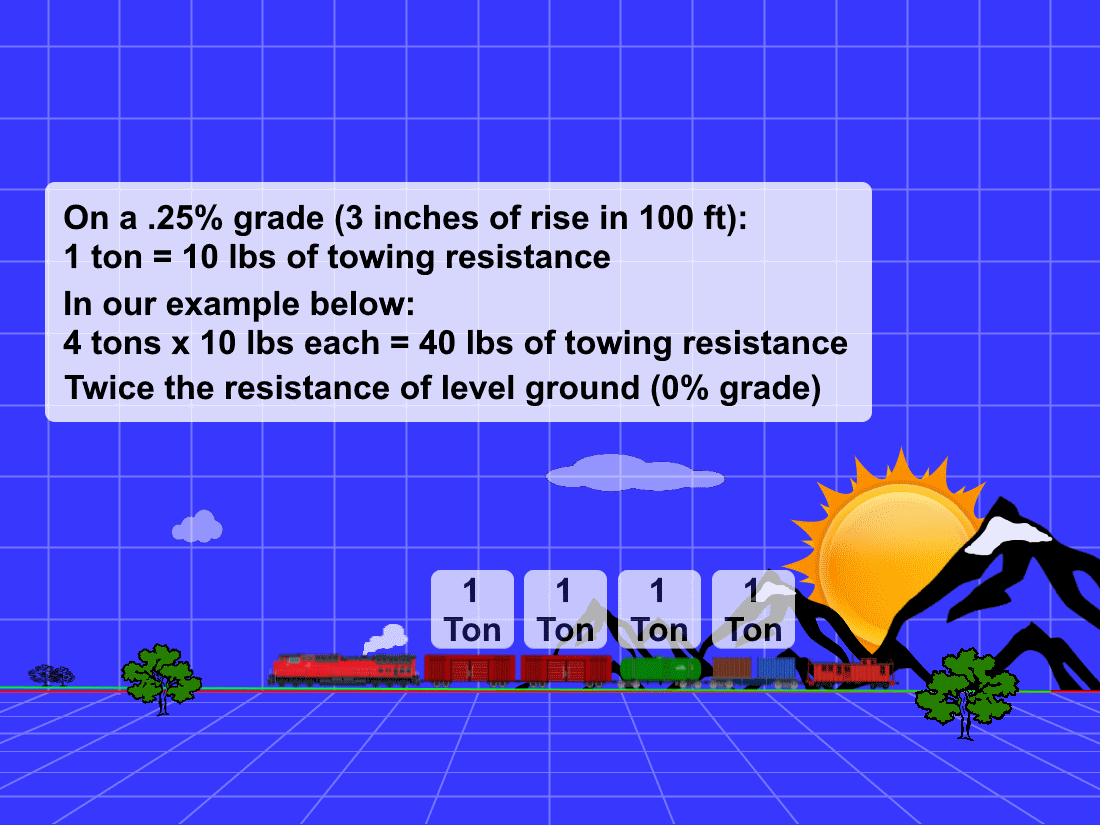
However, as displayed in the following image, if the track elevation is increased to a .25% grade, otherwise known as a “quarter percent grade”, the towing resistance doubles to 10 pounds per 2,000 pounds of load.
That means twice as much power is required to tow the same load, which means at least double the fuel consumption.
In addition, there’s an increase in the time cost because it takes longer to deliver the same load, which is a result of the decrease in speed while traversing the grade.
A .25% grade has a 3-inch rise in 100 feet of track.
Compounding the issue is the fact that towing resistance increases exponentially with any incremental increase in grade. For example, a 1% grade, or 12 inches of rise in 100 feet of track, results in a towing resistance of 20 pounds per 2,000 pounds of load, a 4-fold increase versus the 5 pounds required for a 0% grade! And a 2% grade results in 40 pounds of towing resistance, or an 8-fold increase!
Grades are everywhere and of varying magnitudes. All forms of contemporary transportation are affected by grades, including fixed-wing aircraft, which struggle against gravity as they climb to their cruising altitude, or ocean-going vessels as they ascend waves and swells.
The steepest railroad grade in the US is Raton Pass, New Mexico, at 3.9%, with some state highway grades exceeding 14%.
The image below is a scaled version of a .25% grade. As is displayed, there’s virtually no visible difference in track elevation between the 0% grade (red line) and the .25% grade (green line).
How much can buoyancy reduce fuel consumption?
There are gases such as helium and hydrogen that have a lower density than air, causing them to be buoyant in the earth’s atmosphere.
Their buoyancy can be used to perform work such as lifting a load, but without requiring any fuel consumption.
The significance of this principle cannot be overstated.
Transportation’s struggle with gravity on a slope or grade accounts for at least 50% of today’s global fuel consumption.
To express the significance of this in real-world numbers, in 2019, the world consumed 1.2 trillion gallons of fuel. Imagine being able to reduce that consumption by 600 billion gallons.
Now that’s a commonsense approach to reducing global fuel consumption!

The world's population is growing and so is the demand for hydrocarbons.
How did the human race get to this level of technological advancement, safety, opportunity, and productivity as a society?
By using hydrocarbons to drive the machinery of development and innovation.
The cold, hard reality is that currently, there is no equal to hydrocarbons with respect to energy density and ease of access.
Compounding the issue, 80% of the global population of nearly 8 billion people lives in developing countries. That means approximately 6.4 billion people around the world are striving to reach the level of freedom and development we in first-world countries enjoy and take for granted every day.
It’s simply not reasonable to expect this developing population to mature technologically or in any other way without the use of hydrocarbons. As they mature and increase in size, so will their demand for these natural resources. Denying them access will only result in the stagnation of their economies, which will lead to more poverty, despondency, government corruption, and conflict in these regions.
The logical approach to curbing the demand for hydrocarbons is the development of transportation technologies that genuinely reduce consumption and are good for the environment while not hindering the growth of national economies.
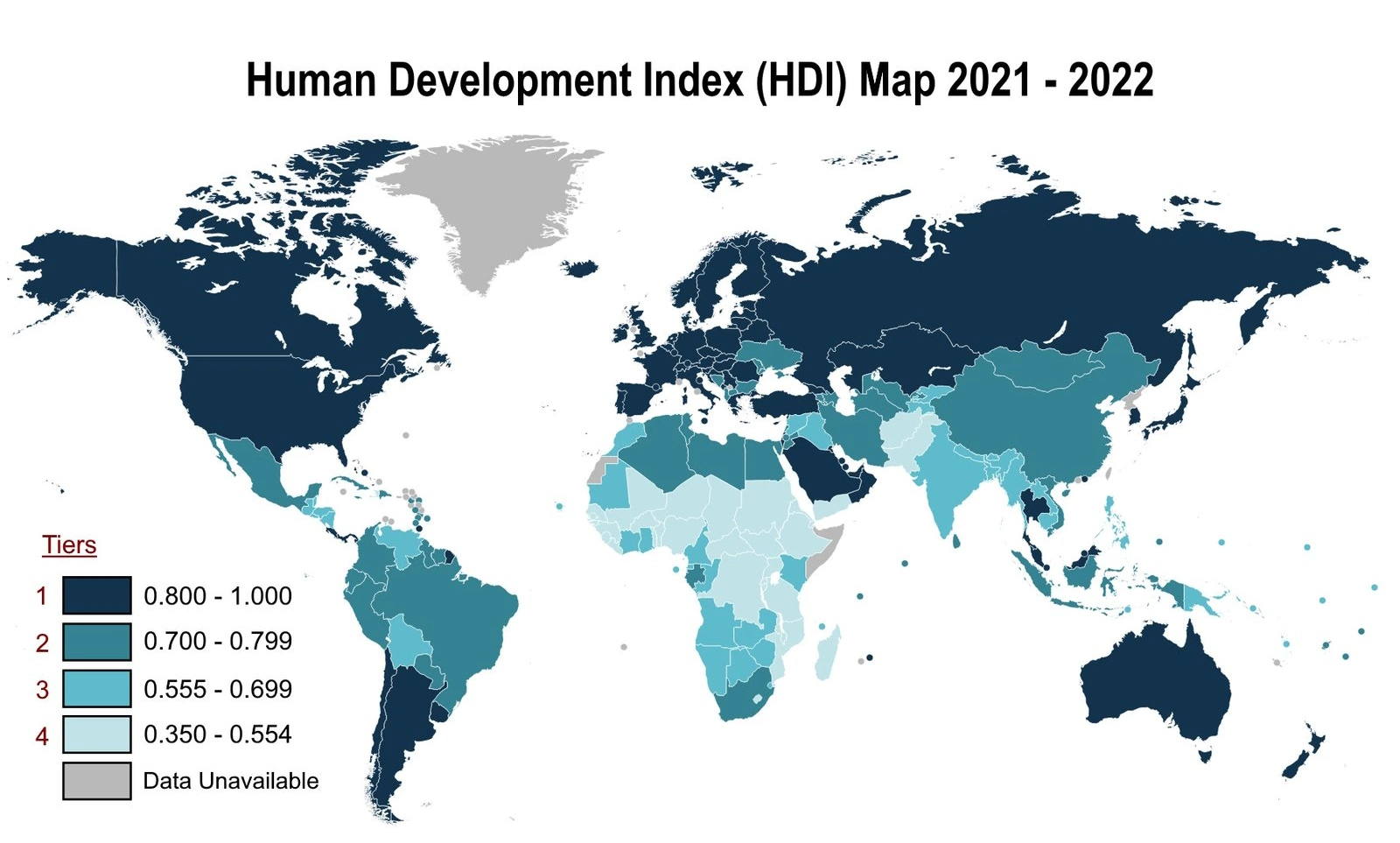
The map below shows the United Nations ranking of the 196 countries of the world using a 4-tier system, with first-world countries like the US shown in the darkest shade.
Currently, there are only 66 Tier 1 countries with a combined population of 1.6 billion out of a total global population of 8 billion people.
As previously stated, 6.4 billion people in 130 countries are striving to achieve the same economic development and freedom that Tier 1 countries enjoy and take for granted every day.
How do we use buoyancy to reduce fuel consumption?
Lighter-than-Air technology (LTA) uses buoyancy to counter the effects of gravity, rendering the payload and aircraft virtually weightless.
We refer to this concept as “Weightless Cargo,” which is one of four concepts that provide LTA with a fuel and time efficiency advantage not shared by any other form of transportation.
With LTA, there is no fuel or time consumed traversing grades because there are no slopes or grades!
For more information on this concept, see our video presentations “Weightless Cargo” and “Fighting the Grade,” available on the “Pitch Deck” page of this website.

Direct Path Access
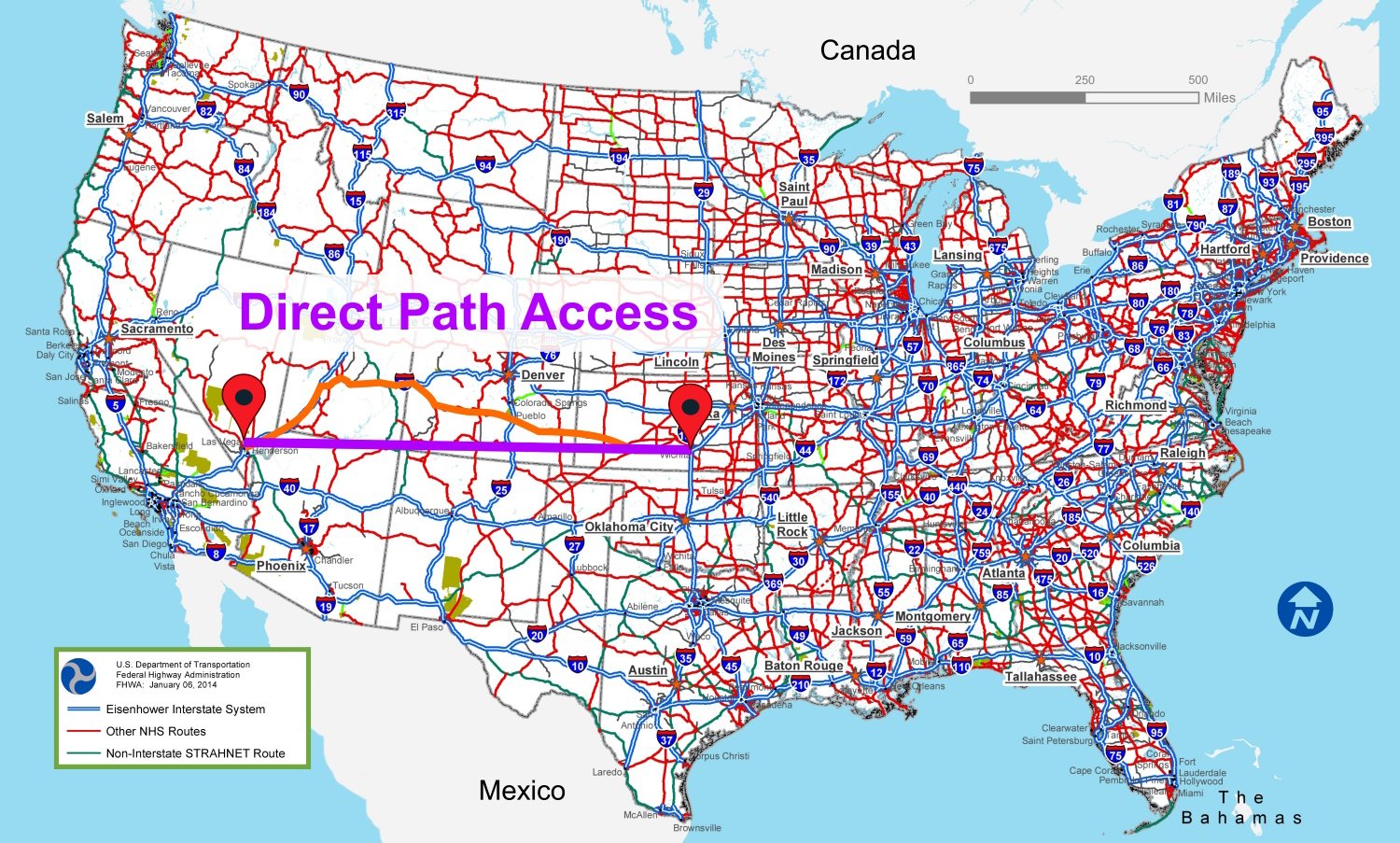
The second concept that further enhances LTA’s fuel and time efficiency is “Direct Path Access”.
Unlike any other form of transportation, LTA can take a direct path from its point of origin to its destination without incurring the costs of an indirect route, traffic congestion, intersections, increasing and decreasing velocities, and changing elevations.
The positive impact that this concept will have on fuel and time efficiency will not be fully realized until LTA is implemented, but it’s not beyond reason to expect at least an additional 30% reduction in consumption.
LTA uses a free and open transportation infrastructure!
LTA uses the earth’s atmosphere as its transportation infrastructure, which provides unobstructed direct access to all geographic locations and requires no maintenance or upgrades.
This is the third and equally important concept.
In contrast, the US spends on average $250 billion per year maintaining and upgrading its roads and highways.
Additionally, the 7 Class I railroad companies in the US spend on average $20 billion annually maintaining and upgrading their tracks and bridges.
The real price is not only reflected in the $270 billion annual cost but also in the consumption of millions of gallons of fuel by the equipment used to build, maintain, and upgrade these transportation infrastructures.
Lighter-than-Air technology not only reduces fuel consumption via the concepts of weightless cargo and direct path access but also by not requiring an extensive and costly ground-based transportation infrastructure.
The Wind is Our Friend!
This is the fourth and final concept, and it affords Lighter-than-Air technology (LTA) yet another advantage not shared by any other form of transportation.
For several millennia, we have used the earth’s wind currents to transport both goods and passengers across vast expanses of water.
As a reliable source of renewable energy, these currents can be used to transport passengers and cargo aboard LTA—no sails required.
And because LTA uses the earth’s atmosphere as its transportation infrastructure, it has the added benefit of not being restricted by coastline.
One example of the effectiveness of this concept is the journey taken in 1930 by the British airship R100 to Montreal, Canada, in which, on the return leg back to Great Britain, she took advantage of the Gulf Stream and was able to reduce her travel time by 21 hours.
For more discussion on this topic, see our video presentation “The Wind,” which is available on the “Pitch Deck” page of this website.

LTA is, by all definitions, a renewable energy technology!
Weightless cargo, direct path access, using a free and open transportation infrastructure, and utilizing the earth’s natural wind currents are all reasons why Lighter-than-Air technology will prove itself the most efficient and profitable form of transportation in the 21st century, beating out all other modes in both time and fuel economy and by providing an unparalleled passenger experience!
Recommended Video Presentations
For more information about the concepts discussed on this page, we recommend viewing the following video presentations on our “Pitch Deck” page: